


How Porcelain Coffee Cups Are Made (And Why It Changes How Coffee Tastes
Porcelain is made from three things: clay, water and fire. What separates it from ordinary pottery is the temperature. Loveramics fire their porcelain at around 1,300°C for long hours, using a specific clay formula, and the result is a body with a water absorption rate below 0.5% — effectively non-porous. That single number is why a porcelain cup does not stain, does not carry yesterday's coffee into today's, and lasts decades rather than years.
Here is the two-minute version, filmed in the factory:
| Typical Firing | In Practice |
| ~1,000–1,150°C | Soft, chips easily, needs glaze to hold liquid |
| ~1,200°C | Durable and heavy; thicker walls |
| ~1,300°C | Thin walls with high strength; vitrified, so nothing soaks in |
Is porcelain the same as ceramic?
No — porcelain is a type of ceramic, in the same way that a flat white is a type of coffee. "Ceramic" covers everything fired from clay: earthenware, stoneware, bone china and porcelain. What distinguishes them is firing temperature and clay body, and those two things decide how porous the finished piece is.
That last row is the reason nearly every specialty coffee bar in the country serves in porcelain. You get a wall thin enough to feel good on the lip and light in the hand, without giving up strength — and a surface that stays neutral no matter how many espressos go through it.
What actually happens in the factory?
The longer film below follows the whole route from raw material to finished cup — forming, drying, glazing, firing, and the water recycling that runs alongside it.
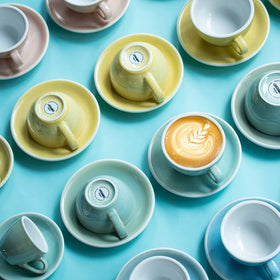
The step most people find surprising is the glaze. Colour in high-fired porcelain does not come from paint — it comes from metal oxides that have to survive 1,300°C without burning away. That constraint is why some colours are common in cheap ceramics and rare in good porcelain: they simply do not exist at that temperature. It is also why Loveramics' reactive glazes behave the way they do, with the glaze pooling and breaking over edges so that no two cups come out identical.
Why does Loveramics make its own cups?
Most ceramics brands design in one place and have someone else manufacture. Loveramics do both — the products are made in the company's own facilities. It is a slower, more expensive way to run a business, and it is the reason the range can carry things like a dripper with three different internal geometries or a bowl whose glaze changes colour at a specific temperature. Those are manufacturing decisions, not design decisions, and you can only make them if you own the kiln.
Design has been led since the beginning by Simon Stevens, an award-winning British product designer who helped start the brand and who designed the Brewers range and the Scandi collection.
Is porcelain food safe?
Yes. Fully vitrified porcelain fired at 1,300°C is chemically stable. The clay and the glaze fuse into a glassy, non-porous surface that does not leach into food or drink, does not absorb liquid, and does not harbour bacteria in the way a porous or crazed surface can. Loveramics' coffee range is restaurant grade, food safe, and dishwasher and microwave safe.
Is porcelain sustainable?
Porcelain is made from natural raw materials and fired into something extremely stable. At the end of its life it does not shed microplastics or release chemical residues — it is, materially, closer to a stone than to a plastic. The environmental argument for it is mostly about longevity: the greenest cup is the one you are still using in fifteen years.
Water use is the other half of the story. Ceramics manufacturing is water-hungry, which is why the recycling loop in the factory film matters more than it might look. There is more detail in Loveramics and sustainability.
How to tell good porcelain from bad
- Weight vs. thickness. Good porcelain feels denser than it looks. A thin wall that still feels solid is a sign of high firing.
- The unglazed foot. Turn the cup over. A fine, tight, slightly glassy ring means a vitrified body. Chalky and absorbent means a lower firing.
- The ping. Tap the rim. Vitrified porcelain rings; under-fired ceramic thuds.
- Staining over time. A porous body will pick up a tea or coffee tint in the crazing within months. A vitrified one will not.
Frequently asked questions
What temperature is porcelain fired at?
Around 1,300°C, for long firing hours. That high temperature, combined with a specific clay formula, is what vitrifies the body and takes water absorption below 0.5%.
What is the difference between porcelain and stoneware?
Firing temperature and porosity. Stoneware is typically fired around 1,200°C and made with thicker walls; porcelain is fired higher, is denser and less porous, and can be made much thinner while staying strong.
Do porcelain coffee cups keep coffee hotter?
A preheated porcelain cup holds heat well because the material has real thermal mass. The bigger factor is preheating — rinsing the cup with hot water before pouring makes more difference than the material choice on its own.
Why are some glaze colours only available in cheaper ceramics?
Colour in high-fired porcelain comes from metal oxides that have to survive 1,300°C. Many pigments simply burn out at that temperature, so the palette available to a high-fired porcelain maker is narrower — and harder-won — than for low-fired earthenware.
Are Loveramics cups made by hand?
They are made in Loveramics' own facilities, combining hand craftsmanship with modern production. Glazing in particular — especially the reactive and ink glazes — involves hand processes, which is why individual pieces vary.
See the material for yourself: browse the full Loveramics coffee cuprange.