


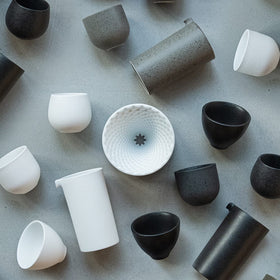

Why the Loveramics Scandi Cup Has No Handle
Because you are meant to hold it. The Loveramics Scandi cup is deliberately handle-less, and the unglazed lower body is the reason it works: raw porcelain is warm rather than scalding to the touch, so wrapping your hand around a 120ml cortado is comfortable rather than a test of endurance. It is a Nordic design idea — the cup as an object in the hand, not a vessel held at arm's length by a loop.
What is the Scandi collection?
Two cups, launched at the World of Coffee show in Copenhagen, designed by Simon Stevens:
| Cup | Capacity | Drinks |
| Scandi Cortado Cup — Ivory | 120ml | Cortado, espresso, dirty coffee, piccolo |
| Scandi Cappuccino Cup — Ivory | 200ml | Cappuccino, flat white, drip coffee |
Both are on the Scandi collection page.
The half-glaze: what it is and why it matters
Each cup carries an ivory reactive glaze on the upper body and rim, with the lower portion left unglazed. Three things follow from that.
- Grip. Bare porcelain has texture. Glaze is glassy and slippery. The unglazed lower half is where your fingers go, and it is the reason a handle-less cup does not feel precarious.
- Heat. The unglazed body reads as warm in the hand, not hot, which is the whole premise of drinking from a handle-less cup.
- Contrast. Visually, the matte-to-gloss transition is the design. It is a potter's finish rather than a decorated one, and it is the reason these cups look at home in nature-inspired restaurants and cafés.
The ivory is a reactive glaze — the same family of potter's colours behind the Reactive Glaze Potters range — so it pools and breaks over the stepped edges and no two cups are quite identical. There is more on how that works in no two cups alike.
Why the stepped profile?
The steps are not decorative. They make the cups stack cleanly, which matters enormously if you are a café keeping cups warm on top of an espresso machine — the sides nest, the stack stays straight, and you can see at a glance how many you have. In a home kitchen it means the same cups fit a shallow shelf without towering.
The steps also give the glaze something to break over, which is where much of the visual character comes from.
Is a handle-less cup practical for everyday use?
For short drinks, yes. For a large latte you want a handle. The rule of thumb is volume: up to about 200ml, a cup cools to a comfortable holding temperature fast enough that handle-less is genuinely pleasant. Above that, the liquid stays hot for long enough that you will want a loop.
That is exactly the range Scandi covers — 120ml and 200ml — which is not an accident. If you mostly drink lattes or big mugs of filter, look at the Egg range or the coffee mugs instead.
What is a cortado, and why 120ml?
A cortado is espresso "cut" with roughly an equal volume of warm, lightly textured milk. It wants to be small — a double shot plus a similar amount of milk lands at around 110–120ml. Served any bigger and the ratio slips and it becomes a flat white. The 120ml Scandi is sized for the drink rather than rounded up to a convenient number.
It is also a good espresso cup if you prefer a slightly larger, open vessel to an 80ml demitasse, and it is the right size for the "dirty" — espresso poured over cold milk — that has been on every specialty menu for the last few years.
Specifications
- Material: vitrified porcelain, stain-proof body
- Finish: half-glazed, ivory reactive glaze over unglazed lower body
- Sizes: 120ml cortado, 200ml cappuccino
- Design: Simon Stevens
- Stacking: stepped profile, designed to nest
Frequently asked questions
Why do some coffee cups have no handle?
Handle-less cups are a Nordic and East Asian design tradition built on holding the vessel directly. They work when the cup is small and the body is either unglazed or double-walled, so the outside stays warm rather than hot. Short drinks up to roughly 200ml suit them best.
What size cup is a cortado?
Around 110–120ml. A cortado is a double espresso cut with a roughly equal volume of lightly textured milk, so a 120ml cup holds it at the correct ratio without headroom to spare.
Is the Loveramics Scandi cup dishwasher safe?
Yes. It is made from vitrified porcelain with a stain-proof body, so it handles daily dishwasher use.
Do the unglazed parts stain?
No. The body is vitrified — fired high enough to be effectively non-porous — so the unglazed surface does not absorb coffee or tea the way a lower-fired ceramic would.
Who designed the Loveramics Scandi collection?
Simon Stevens, the award-winning British product designer who has led design at Loveramics since the brand started, and who also designed the Brewers coffee dripper and dripper stand.