


The Cup That Won a World Barista Championship: Dale Harris Champions Signature
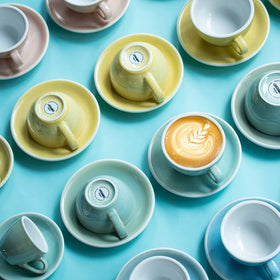
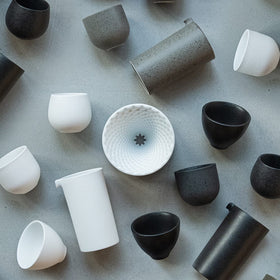
Dale Harris won the 2017 World Barista Championship serving from these cups. The Champions Signature range is the production version of a competition vessel — the shape a barista chose when fifteen minutes and three judges were the only thing that mattered. It now comes in three crackle glazes: dusty pink, yellow and charcoal.
Why does a competition cup matter?
Because at that level the cup is part of the presentation, not a container. A World Barista Championship routine is judged on the drink in front of the judge — temperature at the moment it arrives, how the aroma presents on the first approach, how the crema sits, whether the drink looks the way the competitor said it would look. Every one of those is affected by the vessel.
Competitors think hard about this. Wall thickness changes how fast the drink cools between the bar and the judge's table. Rim profile changes the first contact. The volume has to match the drink exactly, because a shot that half-fills a cup reads as underwhelming before anyone tastes it. Choosing a cup for competition is a technical decision with a visual consequence, and the cup a champion settles on is a reasonable shortlist of one for the rest of us.
What is a crackle glaze?
A crackle glaze is a controlled version of something that is usually a fault. When the glaze and the clay body shrink at slightly different rates during cooling, the glaze develops a fine network of cracks — crazing. Left to chance it is a defect. Engineered deliberately, with the shrinkage mismatch tuned on purpose, it becomes a surface with visible depth, where the craze lines catch light and colour differently to the field around them.
It is a difficult thing to do well and repeatably at 1,300°C, which is rather the point. The three colours:
| Colour | Character |
| Charcoal | Deep, matte-leaning grey-black. Craze lines read as fine light veins. The most serious of the three. |
| Yellow | Warm and bright; the crackle is most visible here because the field colour is pale. |
| Dusty Pink | Muted and chalky. The softest of the three on a shelf. |
The three sizes
- 80ml Espresso Cup — Charcoal. A double shot fills it properly.
- 150ml Flat White Cup — Charcoal. The UK specialty flat white standard.
- 200ml Cappuccino Cup — Yellow or Charcoal. Cappuccino, and enough room for latte art.
The special editions
Loveramics has produced one-off runs of the Champions Signature cups for World of Coffee shows. The 2023 edition, made for the event in Athens, carried an engraving of the Parthenon and was available only at the show.
That was the same week Boram Um of Brazil took the 2023 World Barista Championship title — the kind of coincidence that makes a limited run collectable years later.
Who else has a signature range?
The Champions Signature idea has continued with other competitors:
- Loveramics × Mikael Jasin — tasting cups in 80ml, 120ml and 200ml, in beige, taupe and pink. Jasin won the World Barista Championship in 2024.
- Boram Um Tasting Cups — 80ml, 120ml and 200ml, in a brighter palette of yellow, orange, purple, dusty pink and white.
There are also Champions Signature bean dosing trays — the small, unglamorous bit of competition kit that turns out to be genuinely useful behind a home espresso machine too.
Should you buy a competition cup for home?
If you pull espresso, yes. The 80ml size is the single most common mistake in home set-ups — people serve a double shot into a 120ml or 150ml cup because that is what the cupboard holds, and the drink goes cold and looks thin. A properly sized espresso cup is a cheap fix for a problem most people do not know they have.
The crackle glaze is a separate argument. It is the reason to choose this range over a plain one, and it is entirely about whether you like looking at it.
Frequently asked questions
Who is Dale Harris?
A British barista who won the World Barista Championship in 2017. The Loveramics Champions Signature range is based on the cups he competed with.
What is a crackle glaze?
A glaze deliberately formulated so that it and the clay body shrink at slightly different rates during cooling, producing a fine network of craze lines across the surface. Uncontrolled, this is a fault; controlled, it gives the glaze visible depth and texture.
What size cup do baristas use in competition?
It depends on the course. Espresso is typically served in a 60–90ml cup, and milk drinks in something around 150–200ml, sized so the drink fills the vessel properly. Volume, wall thickness and rim profile all affect temperature and presentation at the judges' table.
Are crackle glaze cups food safe?
Yes, when the body underneath is vitrified. Loveramics porcelain is fired at around 1,300°C to a water absorption rate below 0.5%, so the body is non-porous regardless of the surface effect on the glaze.
What colours does the Champions Signature range come in?
Three crackle glazes: dusty pink, yellow and charcoal, across 80ml espresso, 150ml flat white and 200ml cappuccino sizes.
Browse the Loveramics espresso cups, or see what the current champions are drinking from in the Mikael Jasinand Boram Umranges.