


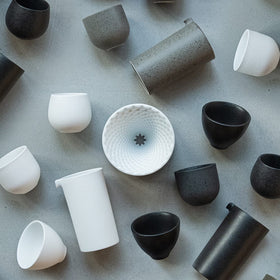

How the Brewers Ink Glaze Is Made (And Why No Two Cups Match)
Droplets of cobalt and black glaze are dropped into a bath of transparent glaze, and then left alone. The pattern on every Brewers Ink cup is the record of how those droplets happened to flow that day — not a print, not a transfer, not a pattern applied to a template. Which is why the collection is called Ink, and why no two pieces come out of the kiln looking the same.
What is the Brewers Ink collection?
It is the original Brewers line-up — first launched in 2017 as a coffee jug and three cup shapes with distinct tasting profiles — reissued in a new hand-applied glaze. Two colourways, Ink Cobalt and Ink Black, across four pieces:
| Piece | Size | Ink Cobalt | Ink Black |
| Specialty Jug | 300ml | Buy | Buy |
| Nutty Tasting Cup | 150ml | Buy | Buy |
| Sweet Tasting Cup | 150ml | Buy | Buy |
| Floral Tasting Cup | 150ml | Buy | Buy |
All eight pieces sit on the Brewers Ink collection page.
How the glaze is actually applied
- A transparent glaze bath is prepared. This is the carrier — it will fire clear.
- Cobalt or black glaze is dropped in, droplet by droplet. Cobalt is one of the oldest and most reliable ceramic colourants precisely because it survives high firing; that is why blue-and-white porcelain exists and why, say, a bright pink equivalent does not.
- The droplets are allowed to flow. No stirring to a pattern, no combing into a design. Surface tension and density do the work.
- The piece is dipped through it. Whatever the surface of the bath looks like at that moment is what lands on that cup.
- It is fired. At around 1,300°C the glaze and body fuse into a single vitrified surface.
The craft is in the control of an uncontrolled process — knowing how much glaze, at what viscosity, dropped from what height, gives a result that is varied without being messy. Get it wrong and you have mud.
Why does it matter that the cups do not match?
Two honest answers. The romantic one: a set where every piece is slightly different has a presence that a machine-printed set does not, and it reads immediately as made rather than manufactured.
The practical one: in a household or a café, it means everyone can tell which cup is theirs. That sounds trivial until you have run a four-person kitchen with four identical mugs.
It is the same principle behind the Reactive Glaze Potters range — we wrote about that in no two cups alike.
Three cup shapes, three tasting profiles
The Ink glaze sits on the original Brewers geometry, so the three cups still do what they were designed to do:
- Nutty — bulbous and rounded, an aroma collector that emphasises chocolate, caramel and body. For South American and darker-roast coffees.
- Sweet — straight, clean lines. The neutral everyday cup.
- Floral — flared opening that lifts aroma. For light roasts, Ethiopians, anything delicate.
There is a longer explanation of the mechanism in how cup shape changes the way coffee tastes.
What does the Ink jug work with?
The 300ml Specialty Jug serves two cups and fits under most drippers — Loveramics' own and other brands'. That makes the Ink set a complete brewing and serving kit rather than a display piece:
- Brew through a Loveramics dripper straight into the jug.
- Sit the dripper on a dripper stand if you want the jug free to move.
- Serve into two of the 150ml cups — same shape for a shared brew, different shapes if you want to compare.
The jug also works perfectly well for sake, tea, or milk on the table. It is a good-looking object that happens to have been designed for coffee.
Care
Porcelain, restaurant grade, food safe, dishwasher and microwave safe. The non-porous body means the ink pattern will not fade or stain over time — it is under the vitrified surface, not on it.
Frequently asked questions
What is an ink glaze?
A glazing technique where coloured glaze is dropped into a transparent glaze bath and allowed to flow naturally before the piece is dipped. The resulting pattern is determined by how the glaze moved rather than by a design, so every piece is unique.
Why is cobalt so common in ceramics?
Cobalt oxide is one of the few colourants that survives high firing intact. At around 1,300°C most pigments burn away, which is why high-fired porcelain has historically been decorated in blue — as in classic blue-and-white ware.
Will the ink pattern wear off?
No. The pattern is in the glaze, which fuses with the body during firing into a single vitrified surface. It is not a printed or applied decoration and it will not wash, scratch or fade off.
Are Brewers Ink cups dishwasher safe?
Yes — dishwasher and microwave safe, restaurant grade and food safe, like the rest of the Brewers range.
Does the Brewers Ink jug fit other brands' drippers?
Yes. The 300ml Specialty Jug is designed to fit under most drippers and serves two cups.
Every piece different — browse the Brewers Ink collection.